Wednesday, November 8, 2017

iPhone for a week: What I learned

Image credit: Android Central

   If you know me you know that I am a big proponent of Android and an enemy to iPhone.  I have complained about Apple's lack of innovation, creativity, and usability for a long time.  Ever since I received my first Android phone back in 2010, I have been comparing the pros and cons of iOS and Android.  Since that time, I have only had Android phones but had many opportunities to use iOS through my iPod and friends' or family's iPhones. I watched dozens if not hundreds of videos about iPhones each year to see what each year's iPhone has to offer.  But this time around I actually decided to try out the iPhone for myself.  I ordered my new Pixel 2 XL and had planned to sell my old Android phone to my sister-in-law once I received it but she wanted a good camera phone for her trip to France so I made a deal to sell it to her early if she gave me her iPhone 6.  Finally I can experience, more than ever, first hand how iOS feels to use on a daily basis and see what it is that so many die-hard iPhone fans and enthusiasts love about it.  This is what I learned.

   I made a list of pros and cons with comparison to modern Android phones.  To make things as fair as possible, the comparisons I make are comparing the most up-to-date versions of each operating system, iOS 11 vs Android 8.0 (Oreo) in an iPhone 6 vs a Nexus 6p (pictured above).  I will also avoid making unfair comparisons like screen size, or things that come to personal preference because it is either a changeable variable amongst devices on both sides or isn't something that can be seen as factual.  I also ignored the slow speed of the iPhone assuming it is based on it simply being a bit of an older device (though my Nexus 6P was also over 2 years old, it has stayed extremely fast).  In comparison with Android, in my short experience (8 days) with iOS I accumulated 3 pros and 79 cons.  The pros and cons will fully be written below but I would like to touch upon a few in particular.  I would also like to note that the cons I list are (1) things that are an issue or something not accessible on iOS that is accessible on most if not all Android phones and (2) things that, if implemented by Apple in iOS, would not force iPhone users to change the way they currently use their devices, but allows them added functionality if they want it.  This way it doesn't feel like a list of ways I want iOS to be more like Android, but rather things I've noticed in Android that make the user experience better, easier, and/or more user-friendly.

   Amongst my list of cons, there are of course easily noticeable features as well as some minute details.  Often the noticeable features show a bigger contrast between Android and iOS but can be seen as user preference, but it's the minute details that really make up each OS (operating system) and let you see how much thought was actually put into each OS.  For those who get bored of just reading, don't worry, there are pictures. :) ;)

Design and Hardware
  Let's start with the design and hardware of each briefly, and then we will move on to the OS.  The iPhone is a pretty device but that really comes down to personal preference. But let's talk about the functional parts of the design. The battery size of the iPhone 6 is 1810 mAH but to make a fair comparison to my larger device, the iPhone 6 Plus has a 2915 mAH. My Nexus 6P has a 3450 mAH.  Even if you don't understand how mAH (milli Amp Hours) works, you can at least understand that bigger the number, the bigger the battery.  Because Apple is always on the quest of "the thinnest phone" title, the battery size, and thus the battery life, suffer.  I experienced this everyday with my iPhone. I would have to charge it at least 2 times throughout the day not including the overnight charge. My Nexus 6P would almost always last a full day on a single charge, usually with 15-20% remaining by the time I go to bed. I also made calls from each device to two different people, one with an iPhone 7, the other with a Pixel XL.  The best call quality was my Nexus to the Pixel, then my Nexus to the iPhone 7. Calls made from the iPhone 6 sounded horrible.  It seemed to me that Apple focused too much on how the phone looked and not how it operated. While I could go on and on about the physical aspects of the phones, let's move to the OS.

The OS
   The operating systems are very very different. Don't let anyone tell you otherwise. Yes there are similarities but those similarities are heavily overshadowed by their differences.  I will be straightforward here, the iPhone drove me crazy.  They don't think of the "little things".  I realized that Apple goes about their operating system in the mindset of "if it ain't broke, don't fix it".  It is a very bare-bones system with very little functionality.  In comparison, if you have a 1965 Ford Bronco that "ain't broke" and works fine, or a 2017 Ford Explorer that of course also works fine, which will you choose? I'm assuming you would go with the latter. Now what if I told you the 1965 Ford also costs 30% more than the 2017 Ford? Not only does the newer Ford cost less, it also has a lot more features ranging from heated seats to a great sound system, additional safety features, better gas mileage, etc.  Not only did the OS feel old, it felt intentionally old. Apple was the first to popularize the "smartphone" and it seems the current OS, ten years later, is still focused on the nostalgia of the first. While Android phones have some features now that were in the first versions of Android 8-9 years ago, those features remain not due to nostalgia, but due to it initially being an innovative, functional idea that still is useful.  In my opinion, the biggest example of this is the home screen and application layout. The first iPhone, as well as all iPhones since, require that you order your apps top to bottom, left to right, like a book.  While that initially may have been a software or coding limitation, Apple decided to stick with it.  If you have 4 apps, those 4 apps have to sit on the very top of the phone. On Android, however, if you have 4 apps, you can place those apps anywhere on the screen; all 4 on top, all 4 on bottom, 1 in each corner, whatever you want. If you have small hands you may elect to put all your apps on the bottom of the screen.  Additionally, there is an "app drawer" on Android that allows you to view all apps alphabetically. This means that you can leave some apps that you don't use very often or at all in the app drawer and off of your home screens. With Apple, whether you use them or not, they have to be on your home screen somewhere. Again, this may have initially been a software limitation with the first iteration of the iPhone, but Apple has decided to keep this to maintain the feel of the first iPhone.  To prove my point, let me provide screenshots of the first OS on iPhone compared to the most recent OS, as well as the first and most recent versions of Android OS:


  As you may have noticed, iOS 11.0 looks very similar to iOS 1.0, yet Android 1.0 is very different compared to Android 8.0.  I would dare say if the apps on each version of iOS were lined up the same and you had the same background you wouldn't be able to tell much of a difference between the two, while on the Android side of things, it would look like 2 completely different operating systems.  Each version of Android made everything more refined, useful, attractive, and user-friendly.  Though you can't see all of the changes just at a glance, you can tell that there are comparable differences.

Another example: Calculators
As you can see, iOS 1.0 and 11.0 are virtually the same, where Android 8.0 and Android 1.0 are very different. Android 8.0 adds functionality, is more refined, and more user-friendly. iOS hasn't changed any functionality, just color.

Minute Details
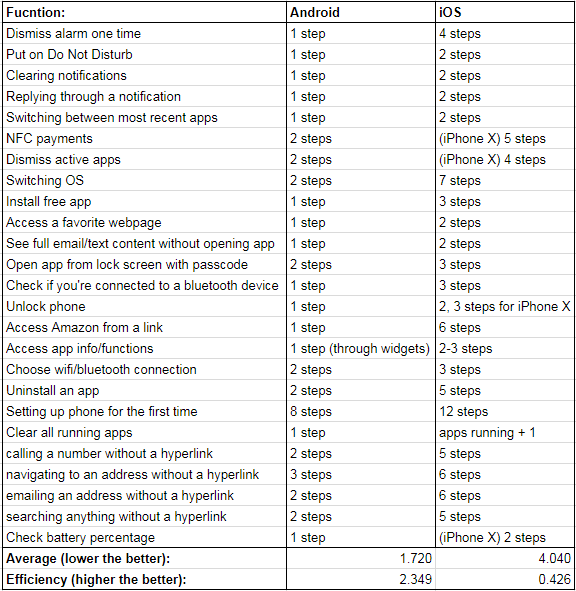
  Some of the little things that I particularly enjoy about Android that you can't experience in iOS include the ability to see in your notification bar whether or not you are connected to your Bluetooth device instead of having to go into your Bluetooth settings to check. I enjoy being able to set my default internet browser, music app, photos app, etc., whereas Apple forces you to use the default apps: Safari, iTunes, iMessage, etc.  I enjoy being able to put widgets on my screen (if you don’t know what widgets are, refer to the image below) so that I can access functions or information from certain apps without having to open them. I enjoy being able to choose the volume of my phone, alarms, and media at any given time.  I enjoy being able to change/choose my WiFi or Bluetooth connections without opening my settings.  I like being able to text (SMS) or make calls over WiFi when I'm in a location with poor reception or no reception. After looking at my "cons" list I realized that there are often just extra steps required on iOS to do the same things on Android. I made a chart to prove my point:
And another:

Widgets (quick access to an app function or app information from your home screen):


So what does iOS have to offer?
   The simple solution to that is exclusivity, status, and possessiveness.  When texting your friends, your texts show up in green when you text friends who don't have an iPhone, and blue for friends who do have an iPhone. When you see green, you exclude yourself from those people and essentially put yourself above them because they don't have an iPhone and you do.  My Nexus' default device name is "Nexus 6P" while the iPhone defaults to "Derek's iPhone". Apple wants you to feel like the phone is part of you and that you should hold that possession close and never leave it.  The cost of iPhones are more than double the average cost of an Android phone which may cause one to personally elevate their status; it makes you feel like you are richer, cooler, and better than those who can't afford such a device.  The iPhone isn't a smartphone, it's a marketing tool. It's a gimmick and a way to think, not a piece of technology.  Apple isn't a tech company, but rather a marketing company.

   The mindset of Android developers and the mindset of Apple developers are very different from one another.  As I once heard, Android says "tell us what you want" and Apple says "we know what's best for you".

  I would suggest reading all of the pros and cons listed below.  There were dozens of things that the designers of Android considered that Apple just did not that makes the user experience better and easier on Android.

   To summarize, Apple focuses too much on how the phone looks physically, and the nostalgia of the OS, and less on how the user interacts with the system.  Android focuses on usability, functionality, multitasking, speed, etc.  Anyone that has had the opportunity to fully experience both, in my mind, should clearly favor an Android phone over an iPhone if they are looking for a device that can give them the best bang for their buck, the best user experience, the quickest navigation of phone functions, and the least frustration.  Though there are a few pros the iPhone holds over Android, they are far outweighed by the cons (again, see below).  Though I will admit I definitely have a bias, I tried to forget my bias in order to see things from both sides, yet I was disappointed in how difficult iOS was to operate, how inefficient it was to use for daily functions, and how little thought was put into the usability of the OS instead of just how the OS looks. Please let me know what I missed either on the iPhone side or the Android side in the comments.


(Again, these pros and cons are in comparison to an Android phone; pros are what the iPhone does better than Android, and the cons are what Android does better than iPhone.)
iPhone pros:
1. Easy to change notification type for each app (ie: whether or not the notifications pop up on your screen, or are hidden, etc.)
2. Quick screenshots
3. Web search from notifications bar

iPhone cons:
1. User data hard to transfer from one OS to another
2. App store is disorganized (https://photos.app.goo.gl/T1pGPddXdwQmfzXw1 - iOS vs https://photos.app.goo.gl/wMuGb46VrXgPRUWf2 - Android)
3. Volume notification in the middle of the screen; blocks view (https://photos.app.goo.gl/ov3gJX5eGfjyFI732)
4. Ringer volume and alarm volume are the same (https://photos.app.goo.gl/rlL8CopX57sIAb0A3)
5. No labels on quick toggles
6. Screen touch accuracy is bad
7. Never get full bars/service
8. "Silent" switch is useless. If it's on silent and you hit the volume rocker it turns the volume on and to go back to silent you have to switch it off and then on again
9. No back button; if an app needs to open another app and you want to go back then you have to open multitasking and select the app again
10. No widgets, can't access app info or functions without opening the app first
11. Can't change default music, always switches to Apple music
12. No quick settings, only quick toggle (WiFi, bluetooth, etc.)
13. Quick toggle hard to access (often scrolls page up instead of opening toggle bar)
14. Quick toggle not customizable (can't move most used toggles to where you want)
15. No quick reply (you can reply from the notifications but it's less efficient, takes 2 steps) (https://photos.app.goo.gl/D3F7RJwPH0Z5xsoI2)
16. Can't just swipe notifications away, have to swipe to the left then press clear (https://photos.app.goo.gl/D3F7RJwPH0Z5xsoI2)
17. Camera app is limited, no fine tuning
18. Again, no back button! Can't get rid of my keyboard without clicking on screen content.
19. Can't get rid of keyboard at all in notes or messages without scrolling up
20. Voice assistant sucks, very limited and sounds unnatural
21. No multiscreen
22. No quick multitasking (switching between most recent apps without having to pull up multitasking window and selecting each app each time)
23. Can't put apps anywhere on screen, hard to organize
24. Notifications are dismissed only from swiping from the very bottom of the screen
25. Notifications take up entire screen (https://photos.app.goo.gl/auD1Puus05MUtePN2 - iOS vs https://photos.app.goo.gl/yx1TR1fHOkG2Jmcl2 - Android)
26. Difficult to place cursor in text
27. Can't set most default apps; Apple rules all
28. Clock setting is inefficient (https://photos.app.goo.gl/7YL5MQnx7ByRndqQ2 - iOS vs https://photos.app.goo.gl/q9Oc2JvyxIv4tZcj1 - Android)
29. No quick charge (for newer iPhones, no quick charge out of the box)
30. Messages app: can't edit contact colors
31. No visual voicemail. It's 2017!!!! (https://photos.app.goo.gl/vsZOTlV7H2JXerNt2)
32. Hard to share data app to app; limited to what Apple allows (https://photos.app.goo.gl/4SzVGvOmoaPlJi6p1 - iOS vs https://photos.app.goo.gl/W4d9xP55GHkLdYyR2 - Android)
33. Calculator has no scientific functions (https://photos.app.goo.gl/RvnukPdt2JQZWjQo1)
34. Can't see battery percentage at the top of the phone (iPhone X)
35. Apps keep crashing
36. Seemingly no smart home control
37. No quick access to camera, extra steps
38. No pattern unlock
39. Multitasking is horizontal; apps are harder to see or dismiss; can only dismiss by swiping up (https://photos.app.goo.gl/ABvuShLAUbPR1Ny93)
40. No third party apps
41. App average cost significantly higher
42. Startup took way too long (even with the newest devices compared to Android)
43. Couldn't set up phone without inserting a SIM card!!!!!
44. App store requires you put in your password to install any app, even if it's free
45. Bluetooth audio volume is same as other media volume
46. Notifications aren't grouped; notification overload
47. No specific webpage access from home screen (no short cuts)
48. Can't expand notification text without opening app or extra steps
49. Can't see active notifications without pulling down notification bar
50. Can't update in the background (OS update requires you completely stop using the phone until it's done updating)
51. Prompts you only for fingerprint when trying to unlock to open a certain app (instead of both fingerprint or passcode (extra step)) (https://photos.app.goo.gl/yunTxK2kL3OECMPy1)
52. Can't toggle notification numbers on apps
53. Booting uses too much battery (I went from 85%-55% when restarting the phone)
54. No notification LED
55. No ambient display
56. Battery life sucks (small battery and inefficient operating system)
57. Can't tell if you're connected to Bluetooth if you're not in Bluetooth settings
58. Sometimes when it's unlocked it still makes you press the home button to go to the home screen. Random. Extra step (https://photos.app.goo.gl/g9AyFISgBS30yRVv1)
59. Pauses music to Bluetooth device when you use Siri or microphone in another app but doesn't resume after
60. Call quality is poor
61. No wifi calls
62. No auto fill
63. No ability within notifications to access functions of an app (example: setting a YouTube video that pops up in the notifications to "watch later")
64. Notifications don't always disappear after you already opened it. Specifically email
65. No SMS over WiFi!!!!!!
66. Can't touch where you want a scroll bar to go, must click and drag
67. Can't tell if phone is on silent
68. Can't change default keyboard
69. Must use Apple keyboard when replying from notifications
70. No option to see WiFi password as you type it
71. Forces you to download apps to access information or products like on Amazon, can't view through simple internet browser
72. Clock doesn't tell you how long before your alarm goes off
73. Can't cancel alarm about to go off without going to clock, turning it off and waiting until the time has passed to turn it back on if you have it on repeat
74. Can't use other browsers, just skins
75. Few battery statistics/data including no prediction of remaining use time or mapping of previous usage
76. Can't reject calls from screen (https://photos.app.goo.gl/E0VwiPVMcTefEueG2)
77. OS updates require too much minimum battery level (40% vs 20% on Android)
78. Too many steps to uninstall an app
79. Settings are poorly organized, doesn't make sense (example: screen adaptive brightness isn't in the "display" settings, but in the "general" settings submenu)

Personal issues with the iPhone:
1: Stupid default keyboard, can't tell when it's capitalized and not
2: Apps don't feel coherent; Apple apps all have different styles/themes etc.
3: Camera app is ugly
4: No good alarm sounds
5: Default apps suck
6: Can't do Do Not Disturb mode from volume rocker
7: Why is there camera access from the notifications menu?? It's accessible from swiping from the bottom already
8. Contacts organized by last name (annoying because most people don't put everyone's last name in the phone, leaves you guessing if you have to find someone by their first name or last name)


Wednesday, October 18, 2017

The Failure of Modern Education

    In our modern society we have widely come to accept a college education as a way of dictating skills, knowledge, and proficiency of a certain field.  A degree is viewed as a required credential of a profession. How accurate is this assumption of one's proficiency in a field when they hold a degree and what does the degree really mean these days?  I would venture to say that today's degrees are becoming less and less of a proof of applicable attained knowledge and skills than the degrees of those decades ago.

    What has caused this change in higher education? Have we changed curriculum? Have students changed professors' expectations? Actually, the real problem with modern education, I believe, is that professors have become more and more lazy.  There are dedicated students committed to reading every page of the textbook, going to every test review, and studying hours for every quiz or exam no matter when or where we look.  However, the methods of teaching are changing constantly.  Decades ago students were taught in class how to do math and physics; they were taught history and psychology.  The professors were not just educated on what their subject of teaching is, but how to use it.  Nowadays, we see more and more professors relying on textbooks to teach students. Classes have become less of a place of lecture and more of a place of review. Students aren't able to rely on their professors for knowledge, rather they must rely on the textbooks and online resources.

    Arguably the in class lectures and the information in the textbook teach the same things, so one could argue that that doesn't change anything, and that students acquire the same knowledge either way. Now, while I believe that college level education should be a good combination of both in class lecture and reading, I also believe the emphasis and focus should be on the lecture. Only there do you get to learn the practical application of what you're learning; only there you are able to test your knowledge and refine your skills; and only there are you able to sift out and separate the most important and least important information.  There is so much information in a textbook that often isn't used in class, isn't part of the curriculum, and/or isn't used in exams.  This means that the good students now aren't the ones who come to class and pay attention, put forth effort to learn, and come to master the subject being taught, but are, rather, the ones who have the most time for reading, the ones with the best reading retention, and the ones best at sifting out what they think is important information.  Those students will test well based off of their knowledge and not on their ability to use that information in a practical application.  That means the more classes that use this method of teaching bring about those who are the best at obtaining knowledge through reading and NOT those who are most proficient at using that knowledge.


    So why are we limelighting those who retain the most information through reading and test well, but not those who show proficiency in applying the information?  This is where the mention of teachers' laziness comes into play.  Firstly, in order for a teacher to best teach a class the application of information and help students individually progress in each field, it requires a lot of preparation.  Powerpoints, lecture notes, and them reading the textbook they require of their students.  It also would require the teacher to create an exam that tests the students' ability to apply the information instead of something that can just be done on a scantron.  However, teachers are required to ensure their students know the material well enough that the majority of students can pass the class and get around a B or B+ average.  In order to remain lazy but ensure students are able to still be testable, we see more and more professors assigning reading assignments and requiring students to teach themselves the material, and then they test the students on what they read and not what they can do.  Lectures can then be a review of material where the professor has to prepare more for clarifying questions, and less for application questions and concept questions that come from teaching new material.

    Not only does this style of assignment reading and self teaching done by professors hurt the potential learning of applicable skills by students, but it also makes students question the professor's expertise and skill in that field. If a professor can't effectively teach and show students they know the material, and show an deep understanding of their field in class, students are less likely to ask questions or go to review sessions and feel forced to learn for themselves.  In fields such as history and philosophy it may not be as detrimental to push so much reading onto students, but in fields that require more hands on applications and calculations, or mental analysis, most people, if not all, will progress and have a higher chance of succeeding when they are shown how to do it.  For example, I have had two different professors for my computer programming class due to me failing the first time around.  My first professor required we learn how to program and type up code by reading the textbook.  Most skills in the book were not used in the required programs he had us make in class and we had to try and figure out which information in the textbook was most important and most likely to be used.  In class "lectures" were just powerpoints where we learned about the history of programming, the concepts of programming, and what programming is comparable to in the world.  Programming isn't much of a conceptual field and is mostly about precise writing, simple math, and problem solving.  He never typed up code, tested programs, or helped us learn how to troubleshoot code errors in class. When it came to doing the homework labs I was left guessing which skill in the book he wanted me to use, and when I ran into a coding error I would be stuck; I didn't know how to troubleshoot and I didn't know what possible things could cause the error.

This is how our quizzes were daily. Never had specific code.

    After failing the class I of course had to take it again but I decided to go with a different professor to see if there was a different teaching style available.  This professor required minimal reading and went over every required skill in class. He typed up code for the class and with the class. He would have the class collectively suggest ideas for the code of the program we were building in class and we would test if it would work. If it didn't work we would, as a class, troubleshoot and learn potential issues that would cause the error. He would also show us how he, as a professional and knowledgeable teacher in the field, would suggest we do it.  He would go over examples from our homework and help us get started on the right foot. He would answer any and all questions we had while making sure we understood how to get the answers ourselves.  Not only did I pass the class this time around, I got an A. More importantly, I knew how to code! My tests weren't written tests with multiple choices, but were application tests where I would have to build a working program.  I was able to confidently ask him questions trusting he knew the answer. I would dare say students who got a B in the second teacher's class were better at programming than those who got an A in the first.

    To summarize, the more lazy teachers become, the more meaningless degrees become in terms of determining qualifications and abilities.  Students learn more information and less skills.  If you were to build a house, wouldn't you rather watch and learn from people actually building a house instead of sitting in a class learning about the history of construction the theories behind the design? Wouldn't you rather learn how to use the construction equipment hands on instead of learning how the motors on equipment being used works?  Applicable information in universities is endangered and teachers who aren't ONLY book smart are dying out. Skilled professionals in universities are disappearing and we as students are suffering for it.  Universities need to focus less on grades and testability and shift focus to the ability to apply and do.  The new way of education suppresses creativity and ingenuity.  Progress as a society and in technology will stop if we continue to be taught what to think and what to remember instead of how to think for ourselves and how to imagine.


Wednesday, January 25, 2017

Obama's Real Legacy


   As the election season came to an end, many people started discussing the "Obama legacy."  Truly Barack Obama has done something with his 8 years in DC, and what does he leave behind?  Today we often connote the word "legacy" as something good, and something that was accomplished that will be remembered.  However, by definition it is what is handed down.  So what did the United States of America inherit from former President Obama?

   Clearly the most signature piece of Obama's administration is Obamacare.  Though the approval and success of it are constantly a matter of debate, we cannot claim that this is part of his legacy whether we deem it successful or not.  The reason for this is that it very well could be repealed within the first few weeks of Donald Trump's presidency.  Didn't last long did it?

   What Obama claims to be his legacy is the progress he helped the LGBTQAAIP(RYSUILMNOP... sorry I have a hard time keeping up with all the identifiers these days) community make.  While homosexuals did get the right to have a federal recognized marriage during his presidency, Obama wasn't the pioneer of the movement, nor does this movement affect much more than 2% of the United States.

   So what is Obama's legacy?  What did he contribute to our country that we will inherit and be affected by for years to come?  The short answer: political correctness.  The long answer:

   First of all, prior to the Obama administration, there were only 2 genders (and there still are.)  However, we see now from the liberal community claims of not just 2, but dozens, if not hundreds of ways to identify your gender that are not "male" nor "female".  Milo Stewart, either an ugly man or an ugly woman, I can't figure out which, made a video where she started #76genders, and then claims that there may be millions of genders, not just 76.  While I hate to admit it, I believe this is part of Obama's legacy.  The rise of political correctness brought out the weird in our world.  While I believe that no voice should be suppressed, confusion shouldn't be touted.  If someone doesn't identify as a male or a female, then they should have therapy, not be given a trophy and told they can do or be whatever they want.  Not only is it unhealthy, it's incorrect.
   Another horrible consequence of political correctness is that of "tolerance."  While we know when a liberal says "tolerance" they really just mean tolerance only of those who agree with them, this movement has picked up a few rocks in its shoes.  One thing that social justice warriors, or SJWs, have started to believe is that everything is ok (unless it's conservative in nature of course.)  Sin starts being seen as permissible because to call someone out for a wrong doing may offend them and SJWs want everyone to feel safe.  I hope they realize how unsafe terrorists are.  Despite the hundreds of terrorist attacks over the years executed by Jihadist Muslims, the liberal tolerance preachers have convinced leftists that because there are good Muslims, we must not fear any Muslims.  This narrative was preached by Obama as well which gave the wayward movement momentum.  I know that SJWs don't understand this but Muslim nations don't treat women and gays as well as the "intolerant right".  While I do not support discriminating someone on their religious affiliation, I have started to question whether calling Islam a religion is correct or not, for we often associate those of a religion to those who have morals, and believe in something naturally or historically good.  However, Islam is neither historically good, nor is it currently evolving into something good.  Despite the fact that there are definitely good Muslims, Islam is not good.
   While I can list dozens of consequences we suffer from the rise of political correctness, we know that Obama wasn't just a proponent of it, but a protector, leader, and enabler of it and its effects.  To it we can attribute the great divide we feel in our country today.  This divide comes in many forms: whites and blacks, republicans and democrats, Christians and agnostics, etc.  Instead of wanting to unite the country, regardless of political affiliation, behind a cause such as extinguishing terrorism or helping the economy flourish, people are now confused what the real fights are, or who the enemy really is.  We enjoy more rights in this country than anywhere else in the world, regardless of your race or gender, yet Obama would have you believe that not only are your current rights at risk, but that you are entitled to even more.  Free healthcare, free contraceptives, free housing, free school.  Not only is nothing free in this world, but those who receive something without a sacrifice of work or of something holding monetary value hardly ever understand the worth of such a gift.  He has got the left to start being apologists for those who may want to hurt us by telling them tolerance means accepting everyone and everything.  Jesus didn't teach tolerance and love of sin, but tolerance and love of people.  Need I remind you what happened to Sodom and Gomorrah?  Jesus doesn't condone sin, and though He loves the sinner, He would not that the sinner continue in their ways.  If He couldn't get them to repent, His way was to eradicate them.  "Behold the Lord slayeth the wicked to bring forth his righteous purposes. It is better that one man should perish than that a nation should dwindle and perish in unbelief."  (1 Nephi 4:13)

   So to summarize, Obama's legacy is not a positive thing as the connotation of the word suggests.  His legacy is something that has made it harder for those with differences to tolerate each other.  Bipartisanship has been thrown out the window and he has accomplished what he set out to do: divide America and weaken the dominant power we once had.  If anything that was accomplished during his presidency is to have a lasting effect, it is that of "politically correct" intolerance, hate, and socialistic ideologies. He has changed the fight to be against capitalism, free speech, and religion instead of toward national security, economic growth, and unity.  Not only is this a legacy that we did not want to inherit, it is one we must oppose.  America was once united, industrial, and free.  Now we are overrun with regulations, taxes, political correctness, and "social injustice."  Obama's legacy must come to an end and like every other obstacle this country has faced, it must come from the working class, the conservatives, the real warriors, the group that ended slavery, segregation, women's suffrage, and much more. It's time to make America great again.

Friday, December 9, 2016

The Path to Utopian Education

   It's no secret that the education system in America is suffering, and graduates are feeling less and less prepared to take on the real world. Not only do they feel less qualified than previous generations, but they are also less able to take on the everyday challenges of the world from things like home and car repair and maintenance, financial planning and issues, as well as how to deal with grief, disappointment, and even with those of whom they simply disagree with. After going to college for over 3 years, I have noticed quite a lot of things wrong with our education system and how it prepares us for the real world. Not only is there a lot that needs to be added to better our education system, a lot also needs to be taken away. First I would like to point out the problems with our education system and then present what I see to be a plausible solution.


   My biggest problem with college is the constant focus on the past. I do understand the importance of understanding history, but what I'm talking about is a bit different. History classes seem to be losing focus on what is important history and what is not. In each of my 3 or 4 history or history based classes, our main focus in class has been what the professor deems important or necessary; in each case this meant if the professor did a study or wrote a book on a certain period of time in history, or if the teacher visited a historic location, they thought their students should learn about it too. Even if what was being taught was important, that importance was not explained and it was frustrating for me as a student to be forced to memorize the events of which I didn't know the significance. I got tired of learning about the names of Chinese tigers and African tall tales.
   Not only did I find the focus of history in each class tedious, but learning outdated techniques and materials just for the sake of history and progression. As a student in the electrical engineering program, I understand the need for many aspects of the required classes. However, when my textbook tells me that the technique being taught is an outdated and unused technique, I start to feel like I am wasting my time. You can learn about how things used to be done without having to learn how to do them. I found it ironic that in each class that requires programming they focus on avoiding unnecessary repetition and useless info, yet they are constantly teaching me redundant information and useless techniques.
   Another issue I see is that of the time required to finish each degree. Don't we want to get people into the workfield faster? If so, why are we making it such a long process? In relation to what I stated above, there are numerous required courses that are not necessary or have no relation or importance to the actual subject of the degree. My brother is studying neuroscience, yet some of his required classes include calculus and physics. Not only did he feel that those classes had no connection to his degree, but during his calculus class, in an attempt to get as much out of the class as possible, each time he asked for the practical application of what he was being taught, the teacher's response was always "you will learn the practical applications of these situations in the next level math classes" which of course were NOT required for his degree. Why are students being required to learn things that they know they will never use?


   One of my personal frustrations with the system is that of textbooks. Not only are a large portion of them overpriced, but some teachers seem to use them for their own profit instead of for the benefit of the class and students. In many of my classes we were required to purchase a new copy of the textbook or lecture material and looking back, there was no benefit to buying a new book because it came with no online access code or anything similar. It seems the teachers just wanted more money for their own written materials and they knew they would get no monetary benefit from the circulation of used books. In my physics class, our teacher got a little greedy and sold his text book for $2,600! It was a required textbook for the class and he updated it every year to try and discourage the reselling of his book. After doing some research I found previous students who said the material was exactly the same in each edition so I found the cheapest copy I could which ended up being a rental of an older version for $400. Either way I felt ripped off and come to find out, I rarely used the book over the course of the semester anyway because it was so poorly written. Students are already struggling to pay tuition, and it makes it much worse when the cost of textbooks is close to tuition each semester. Is this not a form of bait-and-switch? I've even had teachers who didn't offer their syllabus in class or online for free and made students pay $20 just to see it. High school had it right where you were lent a textbook for each class and if you didn't return it or you returned it in poor condition you had to pay, otherwise, there was nothing out of pocket. I would even be fine paying a bit more in tuition so that the university can cover the cost of writing and printing textbooks, but not to the point where it becomes a main form of income for them. I'm even fine with professors advertising their books in class to students and offering extra credit for purchasing those books and writing a paper on it or something similar, but when the teacher requires students to purchase their book that ends up being a form of profit for them then our classes start to become costly, unfair, and dictatorial.
   Lastly, our education system has come to focus too much on written tests, and less on tests of application and know-how abilities. A famous quote by Albert Einstein says "Everybody is a genius. But if you judge a fish by its ability to climb a tree, it will live its whole life believing that it is stupid." When it comes to math tests I do just fine because I can compute and solve problems using math and reason, but when it comes to a test like psychology or history that requires pure memorization, my scores start to decline. The majority of tests don't test who is the most skilled and knowledgeable about a certain subject, but who is the best at memorizing things they hear or read. In numerous classes I have done the best on labs and experiments, but been near the worst on the written tests (which I believe too often hold too much weight towards students' grades). This also always left me feeling like my grade did not represent how I felt about my abilities in that subject.


   One thing I hear from everyone I discuss these problems with is "well we've been doing this for years and if there were a better way, we would have found it by now. This is the best we've got, it is how it is." Not only is this response pessimistic, it's also very wrong. Though we have made millions of technological advances over the last few years, we still know that there is always room for improvement. The reason why education hasn't moved away from it's old ways and innovated is because it doesn't have the same pressure to do so as a tech company does. Apple has competitors, and those competitors have customers. Apple isn't going to feel content with 1 million customers so they are going to do what they can to get more, and if they get more they have to be taking them from their competitors. The more they expand, the more money they can get. When it comes to a university, there are only so many seats. They don't have to compete with other colleges for the same students to the same extent a cell phone company competes with other cell phone companies. If a university continues to get more applications than they have seats available then they feel no need to change or innovate because they don't need more students.   Schools also get government funding, subsidies, and grants which are not dependent on innovation or curriculum taught. Universities aren't affected by a free market system in the same way that product based companies are.


   The easiest way for schools to determine what is necessary and what is unnecessary is is to simply ask "why?" Why are they teaching that subject, or chapter? What practical application does it have, if any? Why are you being tested on that material? The first thing that needs to be done is to prioritize. The general education and core classes seem to consist more of things that you MIGHT come across in the workplace rather than things that you WILL come across. The required classes need to be cut down by up to 50%. Not just general education classes but the degree required classes also fall into the category of "rarely useful". I have been told numerous times that I, as an electrical engineer, will have no use for knowing C++ programming, yet it is a required class. There are probably a dozen or more classes like this so I propose that instead of requiring each one, making them electives. For example, if there are 30 required classes currently, determine the 12-15 most important, and have 6 to 9 required electives. Not only will this help people graduate sooner but it also allows people in each program to choose what within that subject they want to focus on. If a university doesn't want to lower their tuition with these types of changes, then they can use the new excess gained through less classes to invest in more student projects and new equipment. In the last 20 years we have made major technological advances, yet in my electrical engineering class we are using 20 year old equipment which is not acceptable for a top level university. Also, a program could be arranged in which those who have graduated from the university, while in the workplace or searching for a job, if needed, can return to the university at any time to take other electives to help them in their career or refresh their knowledge on previously taken classes. This encourages schools to focus on better teaching to try and avoid graduated students returning (though it would not be costly if they did.)
   As for the subject of general education classes, I believe we need to do a complete overhaul. The argument in favor of general education classes is always that they are to help us be "well rounded", to which my response is, whose definition of well rounded does that follow? Instead of requiring 3 history classes (US history, world history, humanities, etc.), why not 1? We can then eliminate classes to help people graduate faster or replace them with classes that would help what I see as being well rounded, such as money management, strengthening your marriage relationship, how to care for and raise a child, or how to maintain and repair your car, home, and yard. One of the biggest complaints I hear from students are in regard to general education classes, not only because they are unnecessarily hard, but they are unnecessary period. The 20 or so required general education classes need to be condensed to focus on basic necessities of life, such as math, language, finances, and other things that we actually will come across on a daily basis. Not only should we decrease the amount of required general education classes to 10 or less, we should also focus on more important, applicable subjects for those classes.


   In regards to written tests, we should get rid of them in all major-specific classes, if not altogether. Because classes such as history are classes of pure memorization, I can't think of an alternative way to test, but when someone is learning a skill, they shouldn't be required to TELL the university how good they are through written test results; rather, they should be able to SHOW how good they are through application of what they learned. The only class I have had in all my years of college that has gotten this right is my computer programming class (despite my opinion of it being an unnecessary class.) Each of our exams aren't written tests asking about how to code or the history of coding, but are simply a test of whether or not we can code. They give us a task and require we write a code to accomplish that task. Not only have I done well in this class because of this, it has also helped my confidence in the subject due to me being able to avoid the chance of scoring poorly again on a written exam on a subject I know (or thought I knew) that I was skilled at. In high school my physics class was graded on how well we could use the physics we learned and apply it to in class experiments. In college, my physics class is graded on how well I can do homework problems and written tests. There are labs also required in the class but they contribute to less than 10% of my grade. Despite the content of both physics classes being very similar, I did much better in high school physics, and I have done each of the labs in my college physics flawlessly, but my grades in my college physics class don't reflect my ability to do physics in real world applications due to the numerous tests and homework assignments. These types of things make people get discouraged, lose motivation and confidence, and feel like the fish in Albert Einstein's analogy.
Another point to the subject of tests is the fact that students are often not allowed any materials to help them. In each of my calculus classes we have not been allowed a calculator and in my physics class we were expected to memorize over 200 equations for the tests. This is not practical and forces unnecessary memorization and study time focused strictly on memorizing equations instead of learning how to use those equations. In some cases, textbooks and the internet should be allowed, because that is what we have access to in the real world.  Without change it is very impractical and unrealistic.
   To summarize, degree specific classes should be more specific, and general education class options should consist of more topics to help us be better citizens and "well rounded" in everyday situations. Class lectures should consist of less long lectures and more experiments and applying the lecture material. Less written tests should be administered and more application tests should be standard. Textbooks should not be used as a form of business and income, rather for its intended purpose, which is to help educate the students.  And finally, each class curriculum should be condensed and concentrated on things that are important, useful, and applicable. Through these means I can foresee a smarter generation with more skills, less student loans (due to less time in school), and more confident citizens.

Sunday, November 20, 2016

To Be Made Whole


   As Christ was on his way to Jerusalem during his ministry, he was met by ten lepers.  They said to Christ:
"'Jesus, Master, have mercy on us.'  And when he saw them, he said unto them, 'Go shew yourselves unto the priests.'  And it came to pass, that, as they went, they were cleansed.  And one of them, when he saw that he was healed, turned back, and with a loud voice glorified God, And fell down on his face at his feet, giving him thanks: and he was a Samaritan.  And Jesus answering said, 'Were there not ten cleansed? but where are the nine?'  There are not found that returned to give glory to God, save this stranger.  And he said unto him, 'Arise, go thy way: thy faith hath made thee whole.'" (Luke 17:13-19, quotations added)
   This concept of becoming whole has been on my mind lately.  What does it mean to be made whole and how do we achieve this?  Christ commands us that we must be perfected through Him, but is this how we become whole?  Though Christ does want us to use the Atonement and strive for perfection through Him, becoming whole is something we must work on at a personal level.  When Christ asks us to give ourselves unto Him, he expects all of us to be presented.  Just as when you ask for an apple, you don't expect only half an apple.  However, being made whole as a human involves many aspects of our lives becoming whole, not just one.  When you want an Apple iPhone, you don't expect half a screen, a whole processor, one of four functioning buttons, and three fourths of the electrical components.  To be made whole, we must first take a step back and consider the main aspects of life: physical, mental, spiritual, emotional, social, and intellectual.

   Physical

   "Know ye not that ye are the temple of God, and that the Spirit of God dwelleth in you?  If any man defile the temple of God, him shall God destroy; for the temple of God is holy, which temple ye are." (1 Corinthians 3:16-17)

   In a world that seems to continually become more and more corrupt we start hearing many claims that I imagine make God disappointed.  One of those claims is "my body my choice".  Obviously we are in control of our body (most the time) so how could this claim be false?  From a logical standpoint, you don't own something until you purchase it, or it is given to you.  I believe that a common misconception is that God gave us our bodies, thus it is now ours, but throughout the scriptures God reminds us that our bodies are a possession of God.  "Know ye not that your body is the temple of the Holy Ghost which is in you, which ye have of God, and ye are not your own?" (1 Corinthians 6:19)

  God has loaned us our bodies, and he has the power to take them away.  Until the resurrection, our bodies and our spirits are not inseparable.  God gives us many gifts throughout our lives, and he expects us to take care of each one.  To become physically whole, we must also break this down into various pieces.  Among other things, we must treat our bodies right, we must learn to overcome physical lusts, and we must avoid flaunting our bodies and avoid immodesty.  Through various means, not only can we become healthy, but we can treat our bodies as a temple and become whole.

   Mental

   One major aspect of becoming mentally whole is ensuring your mind is clear and strong.  Alcohol and other drugs affect our physical health negatively, but they also hurt and retard our mental abilities.  With our bodies, God gave us an amazing brain, more complex, more creative, and more able than any computer in the world.  These innate abilities can only be fully harnessed through mental clarity and mental strength.  I believe another aspect also includes mental attentiveness and awakeness.  We must be aware of what is going on around us, pay attention to the people in our lives, and be sincere in everything we do.

   Spiritual

   In church we hear hundreds if not thousands of different ways to become spiritually strengthened.  Often we focus too much on spiritual "strength" and neglect other aspects of our lives.  With that said, it is as equally important as any other category and must be a high priority.  Being spiritually whole consists of coming closer to God through church, prayer, and sincere scripture study, being morally clean in thought and in action, not judging others, and serving others in any and every aspect we can.  "For to be carnally minded is death; but to be spiritually minded is life and peace." (Romans 8:6)

   These first three sections of becoming whole can be summed up in the last section of the scout oath: "To help other people at all times; to keep myself physically strong, mentally awake, and morally straight."

   Emotional

   Being emotionally whole doesn't only involve our own emotional strength and stability, but being emotionally aware of those around us.  For our own emotional strength we must learn to feel love for our fellow men, oust hate in our lives, and avoiding taking offense from those who are also imperfect.  The idea of political correctness was invented to protect those who are emotionally unstable and, while we must be aware and loving toward those who may not have sufficient emotional strength, we must also strive to keep our own emotions in check, and not force them onto those with whom we disagree.  "Master, which is the great commandment in the law?  Jesus said unto him, Thou shalt love the Lord thy God with all thy heart, and with all thy soul, and with all thy mind.  This is the first and great commandment.  And the second is like unto it, Thou shalt love thy neighbour as thyself." (Matthew 22:36-39)

   Social

This is the topic in which I believe the most confusion in our society exists.  Hypocrisy, discrimination, one-sidedness are just a few problems that exist in our society, most of which surface amongst debates and discussions.  The best way to build social wholeness is to consistently and constantly examine and assess our social interactions.  Was I hypocritical?  Was I unfair?  Did I listen and consider differing opinions.  The easiest way to depict an image of social incompleteness is to think of how one-sided we often may be.  Just as everything has at least 2 sides, to be socially whole we must not be one-sided.

   Intellectual

   God wants us to be educated in all matters.  He wants us to strive for knowledge to benefit us, our families, and those around us.  The technologies and conveniences of our generation have been brought about by those who took the time and put forth the effort to better themselves to better society.  Our intellect will help us get jobs, deal with life, and solve problems.  When you are taking a test, God won't give you the answers you seek just because you are spiritual, rather he will help you if you put forth the effort to study, and to know for yourself.  Being intellectually whole means being knowledgeable, logical, and always seeking to know more.  "And if a person gains more knowledge and intelligence in this life through his diligence and obedience than another, he will have so much the advantage in the world to come." (Doctrine & Covenants 130:19)

   Becoming whole is not just an achievement of overall improvement, but is a constant for which to work for and strive.  The reservoir of our perfection has a leak and must constantly be filled to help us reach our potential, and to reach heaven.  Only through constant examination and correction can we become whole through our own efforts, and through Christ.  "But the fruit of the Spirit is love, joy, peace, longsuffering, gentleness, goodness, faith, Meekness, temperance: against such there is no law.  And they that are Christ’s have crucified the flesh with the affections and lusts.  If we live in the Spirit, let us also walk in the Spirit." (Galatians 5:22-25)